Microsoft AI Rollout Readiness
Approve Microsoft AI agents safely
Validate production reach across Copilot, Foundry, Entra, Azure, Graph, Sentinel, and Defender before access is approved or reduced.
Review Microsoft AI ReadinessMicrosoft rollout reviews need connected context.
Copilot, Foundry, Entra, Azure, and Graph each show part of the picture. Security needs the connected execution path.
Service principals, managed identities, OAuth grants, and delegated permissions remain the infrastructure underneath the agent approval decision.
Common Microsoft rollout patterns
Recurring approval blockers across Microsoft AI agent rollouts, tied to specific access paths and production systems.
Agents or identities with no valid owner
An agent, service principal, managed identity, or delegated permission remains active in production without a valid accountable owner.
Service principal owner departed. Runtime identity: not assigned.
Permissions beyond approved scope
The agent still runs, but the service principal or managed identity behind it now has broader Entra roles, Azure permissions, or downstream production access than originally approved.
Agent paths to AI services or external endpoints
An agent path touching sensitive data can also reach AI services, external endpoints, or additional Microsoft services not reviewed as part of the original rollout.
What the platform surfaces
- Which Microsoft AI agents ran and what they changed
- Which Entra identities, Azure permissions, Microsoft Graph permissions, service principals, managed identities, or delegated permissions were used
- Where permissions drifted from approved scope
- What touched production systems, data domains, or external services
- What may be affected before access is reduced or removed
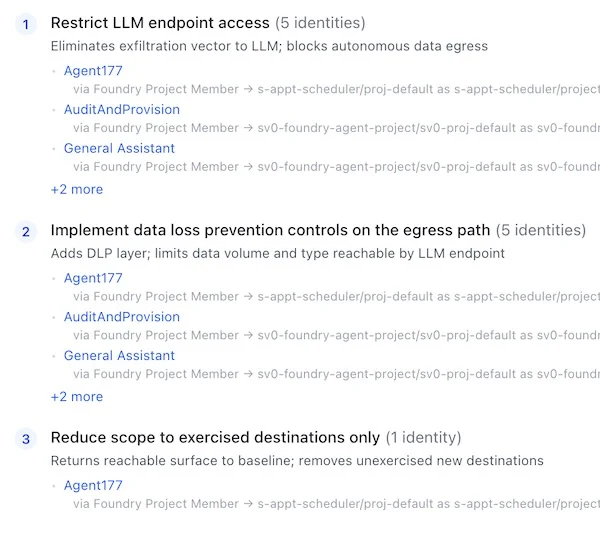
Findings your team can act on immediately.
Decision-ready action groups
Microsoft agent risks grouped by agent, identity, affected system, and remediation path
Access rehearsal included
See what may be affected before access is reduced or removed
Workflow-ready format
Structured for direct handoff into ServiceNow, Jira, Sentinel, Defender, Splunk, identity, or owner workflows
SOC and identity context
Approve current access, reduce scope, review ownership, enrich SOC context, or route an access decision
This is relevant if…
- Copilot, Foundry, or Microsoft-adjacent agents are moving toward production approval
- You need to prove what executed across Entra, Azure, and Microsoft Graph
- You need to know what may be affected before reducing or removing Microsoft AI agent access
Validate your Microsoft AI rollout.
See execution, change, production impact, and next action.
Review Microsoft AI Readiness