Approve agent access with confidence.

Decide whether authority fits approved intent, understand the expected impact of a correction, and initiate approved work through your systems.

Start an evaluation

Know when an agent can do more than its job.

A role, trust relationship, or feature approval can create authority across connected systems beyond the scope of an individual control. SecurityV0 reconstructs the reachable action and identifies where authority extends beyond the owner-approved scope.

Prioritize authority that puts production actions or sensitive data at risk.

See what you are approving.

Bring configured authority, observed execution, accountable ownership, owner-approved scope, affected systems, and expected impact into one decision.

Which agent or agentic workflow can perform the consequential action
Which service account, managed identity, OAuth grant, role, or delegated permission carries it
Where configured reach or observed execution exceeds the owner-approved scope
Which accountable owner must confirm intent when approval evidence is missing
Which systems, workflows, and data domains the action can affect
The prioritized outcome: Approve, Constrain, Reject, or Unknown—and why
The accountable owner, expected impact, and supported control action

Approve, constrain, reject, or keep the decision unknown until the accountable owner resolves the missing evidence. Observed behavior never establishes approval.

SecurityV0

Example D-024 · Action approval

Constrain production booking-data access

Owner: Cloud Platform · Modeled impact · Customer approval required

Constrain

Why

A new trust relationship makes production booking data reachable outside the approved cost-analysis job.

Approved route

Billing data → Cost analysis

Bypass route

Delegated role → Booking data

Review decision

Stops: production booking-data path
Keeps: approved cost workflow
Unknown: unconnected routes
Keep Unknown Initiate workflow

After approval, the authorized customer team applies the control through its own systems.

Approve authority across the systems agents actually use.

Evaluate authority across the connected identity, cloud, AI, workflow, and application systems your agents use. Prioritize the actions that need review across that surface.

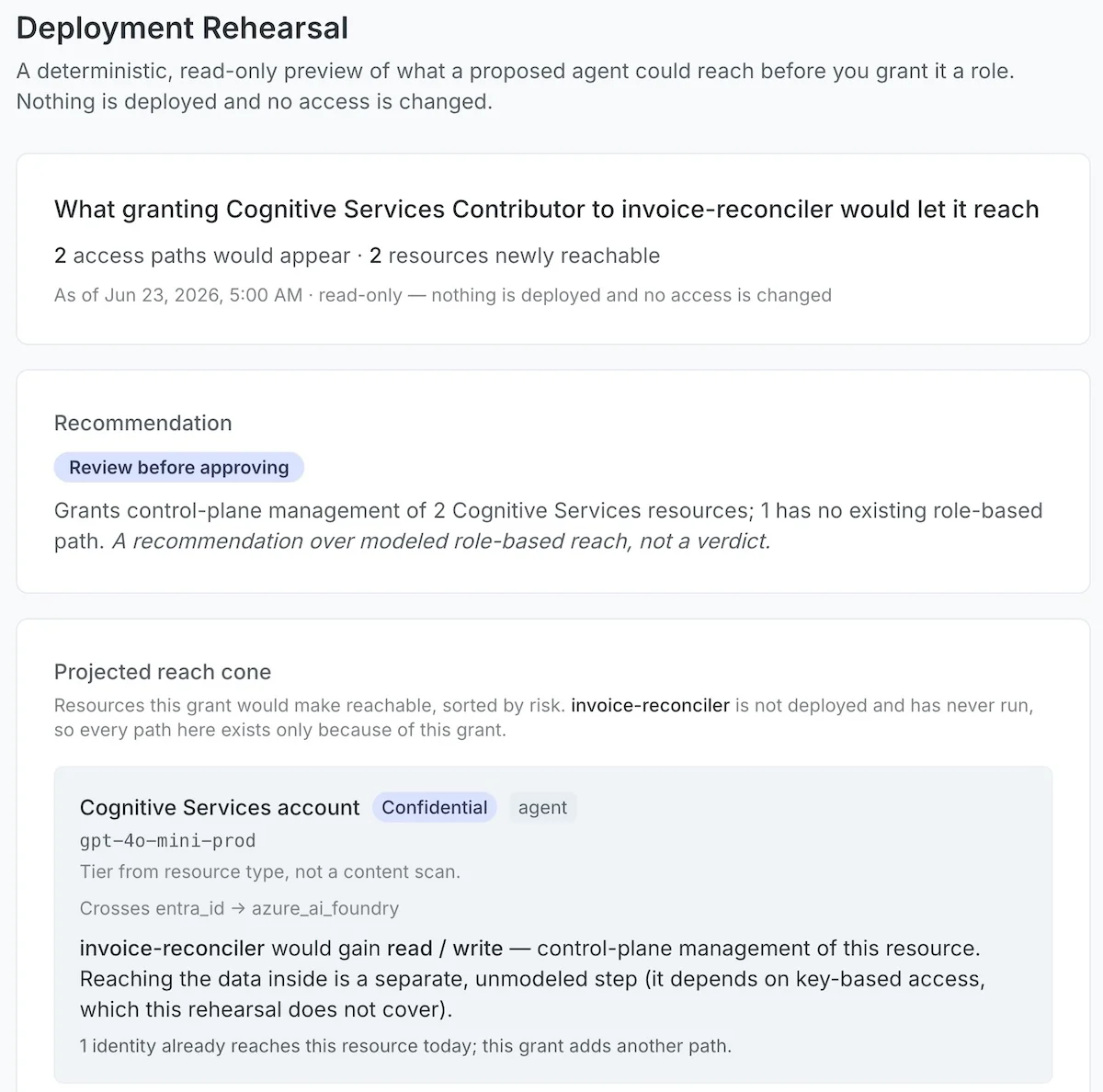
Confirm scope before deployment

Confirm that reachable authority matches the agent’s owner-approved scope before it enters production.

Review expanding access

See how a new role, trust, tool, or workflow changes the actions the agent can take.

Control drift after approval

Reassess access when permissions, execution, ownership, or approved purpose changes.

Correct drift through your existing systems.

Get the lowest-impact supported correction, see what should stop, keep working, remain exposed, and stay unknown, then initiate approved work through customer workflows.

Choose a supported correction

Make the decision with the authority, approved purpose, ownership, and expected impact behind it.

Act through your systems

Initiate the human-approved work through the customer workflow responsible for the affected authority. Your authorized teams apply the change.

Keep authority governed

Re-evaluate the decision as authority, observed behavior, ownership, or approved purpose changes.

See Change Impact Analysis →

Give the accountable team what it needs to act.

Send the same authority, execution, ownership, impact, and control context to platform, identity, security, workflow, and application owners.

Know the approved correction and expected impact
Give identity and cloud owners the supported access change
Understand the authority and execution behind the risk
Route owner review with production context
Initiate approved work through customer workflows
Keep the decision current as authority and execution change

Make the control decision clear to every reviewer.

Give every reviewer and operator the same decision context without translating another findings dashboard by hand.

Prioritize related actions

Group related decisions by agent, identity, workflow, affected system, accountable owner, and control path.

Understand the decision

Show configured authority, observed execution, owner-approved scope, ownership, dependencies, expected impact, and outcome.

Put approved work into motion

Package the decision, approved disposition, accountable owner, and supported correction for identity, cloud, SaaS, workflow, and application teams.

Keep leaders informed

Give security leadership, risk, audit, and SOC teams the decision, reason, action status, and current authority state.

Make the next production decision with evidence.

Connect the relevant systems, prioritize consequential actions, and validate the supported correction, then reassess as authority changes.